
I Did Two Yoga Teacher Training in Bali. Here’s How to Find Yours.

In 2017, I had my first yoga class. It felt good in my body. In my mind. I know it can’t solve all my problems, but somehow, right there, I stopped needing to be elsewhere.
Yoga was there whenever I needed to clear my head, take care of my body, or sit with a big decision. Career. Relationships. Moving.
In 2023, I ended up taking a 200-hour yoga teacher training in Bali. Quit my job. Taught in studios and hosted retreats. Then, I went back for my 300-hour.
I didn’t know, back then, how much a YTT would shape my life. Now, after taking two YTTs, learning about different schools from other people, and teaching for three years, I want to give you something more useful than a list.
This isn’t a ranking. It’s a guide to finding which yoga teacher training in Bali is best for you.
This post contains affiliate and sponsored links. If you book through them, I may earn a small commission at no extra cost to you. I appreciate your support! Read our full disclosure.
Two Questions Before You Find Your School
There are two questions I wished I asked myself before even looking for a YTT school. And no, it’s not the price or the location.
Question 1: Why do you actually want to do this?
Do you want to teach or deepen your yoga practice? Are you looking to improve your asanas or go deep into the philosophy of yoga? Or is it more of a holiday for you?
Being aware of your intentions will help you shortlist schools and eventually decide on one.
Question 2: What style of yoga do you want to learn?
Every YTT has a different focus. Although most 200-Hr programs have Hatha as a base, there are also a few that offer multi-style, Ashtanga, Vinyasa, or Yin.
Hatha: Traditional. Foundational. Strong emphasis on breath, alignment, and philosophy. Perfect for students who want to understand yoga as a whole, not just as movement. Personally, this was the style I was drawn to for years.
Ashtanga/Vinyasa: Physically demanding, structured sequences, breath-movement synchronization. This one assumes you already have a regular practice. But if you want a strong technical foundation, Ashtanga gives you that more than any other style.
Yin: Slow, focused on connective tissue and holding poses longer than you think you can. If you’re drawn to the therapeutic or energetic side of yoga and Eastern medicine, this is the style that goes deepest in that direction.
Multi-style: Broader exposure across different styles. Aside from Hatha, this is what I’d recommend for beginners to experience different styles and find one that connects with you. I had this experience with House of Om and eventually found my love for Hatha.
Do Not Decide Based on Price Alone
YTTs are expensive. Let that first sink in.
You’re paying for teachers, accommodation, meals, certification support, and in many cases excursions and community programs.
When I was looking for my YTT, I just looked for which one was the cheapest with a good program. Although I ended up with a great experience, I later found out that I liked a smaller group, which makes it more expensive.
Have a budget. But don’t decide based on price alone. Your YTT will shape your yoga journey, especially if you choose to teach afterwards.
If you’re planning to stay on after your training, I have a guide to where to stay in Bali, that covers the different areas around Ubud and Canggu in practical detail.
6 Best Yoga Teacher Trainings in Bali and Which One Fits You
I did my 200-hour YTT in Bali at House of Om in 2023, followed by a 300-hour YTT with SKY Yoga and Meditation. In between, I met a lot of people along the way who also shared their experience with different schools.
These aren’t the only schools in Bali, but they’re the ones I’d recommend for your first YTT based on what I’ve experienced, heard, and know now.
House of Om
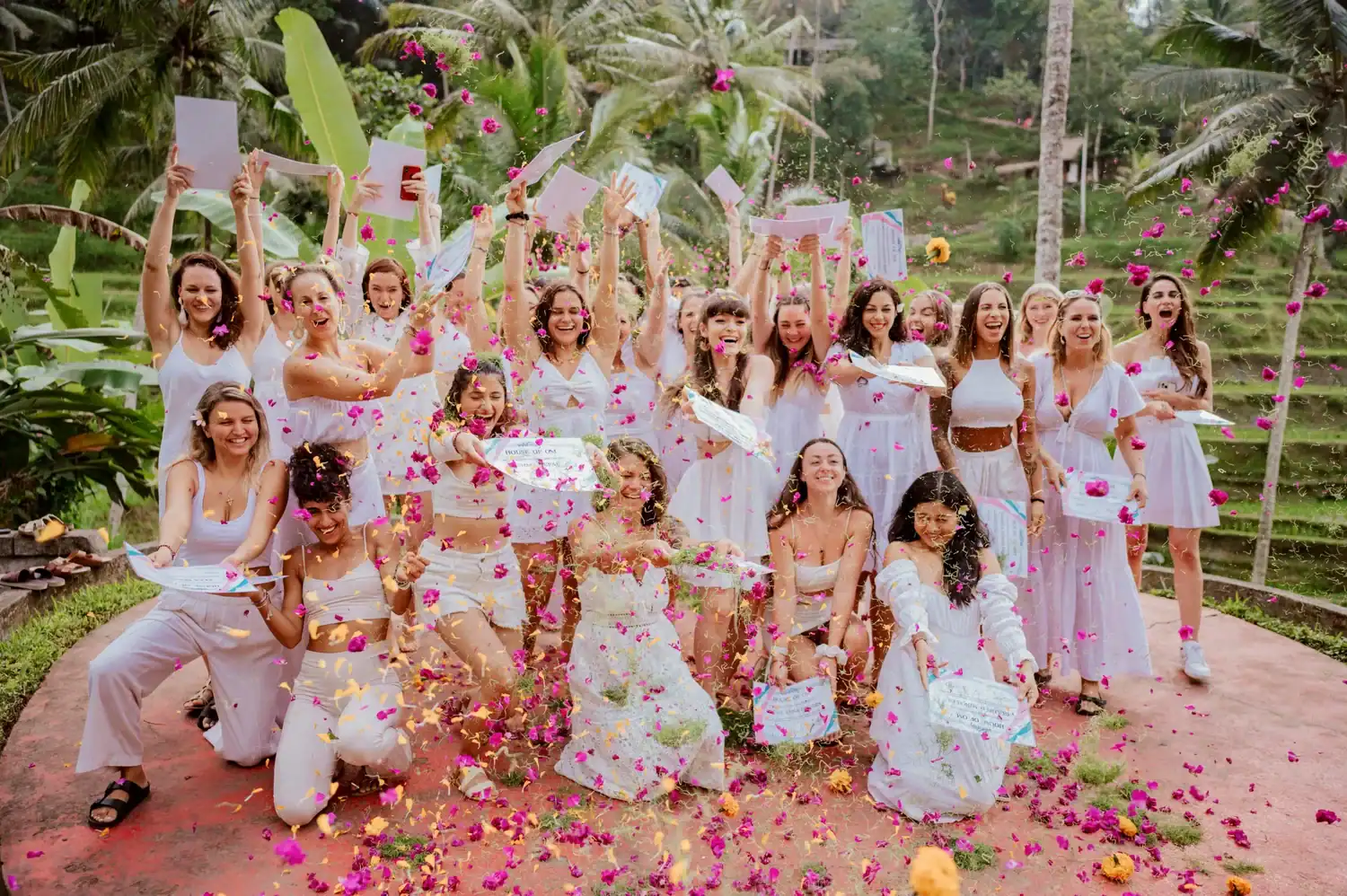
If you’ve started looking for a YTT on Instagram, you’ll likely encounter House of Om. They have a strong presence on social media because of many factors, especially the community they’ve built.
This is why I think House of Om is best for your first YTT. YTT is hard on the body, on the mind, and sometimes emotionally too. House of Om makes it easier with the sense of community they build around you.
Aside from peer feedback, we also worked on group presentations, open circles, gratitude rituals, and excursions that allowed us to connect with one another. I remember around the second week, several students were physically and emotionally exhausted, but we were there for each other.
House of Om has three locations in Bali: Amertham, The Mansion, and Pelaga. Amertham is located in a quiet jungle about 25 minutes from Ubud. The Mansion is more like a boutique resort in the Ubud area and Pelaga offers a deeper isolation in the mountains, forests, and waterfalls. I did mine in Amertham.
House of Om offers a multi-style YTT covering Hatha, Vinyasa Hatha, Vinyasa, and Ashtanga Half Primary Series. We also had classes in philosophy, meditation, teaching methodologies, anatomy, and pranayama. We even had two teachers with more than 10 years’ experience from Rishikesh.
The food deserves a mention too. It’s vegetarian, colorful with so much variety. Their healthy desserts were something we were all looking forward to every dinner.
That said, it’s not perfect. Among all the schools here, House of Om has the most number of students. We were 26 (separated with two groups) when I did my 200-Hr with House of Om. I felt that I got less adjustment to accommodate the bigger group.
That said, they are the most affordable school in this list and in Bali. House of Om’s 200-hour YTT early bird starts at $2,125, all inclusive for a dorm room.
House of Om is best if you’re a beginner looking to deepen your yoga practice and learn different styles. It might not be the best fit if you want intensive, focused one-on-one asana adjustment or if you prefer silence and deep introspection over group social energy.
Sky Yoga and Meditation

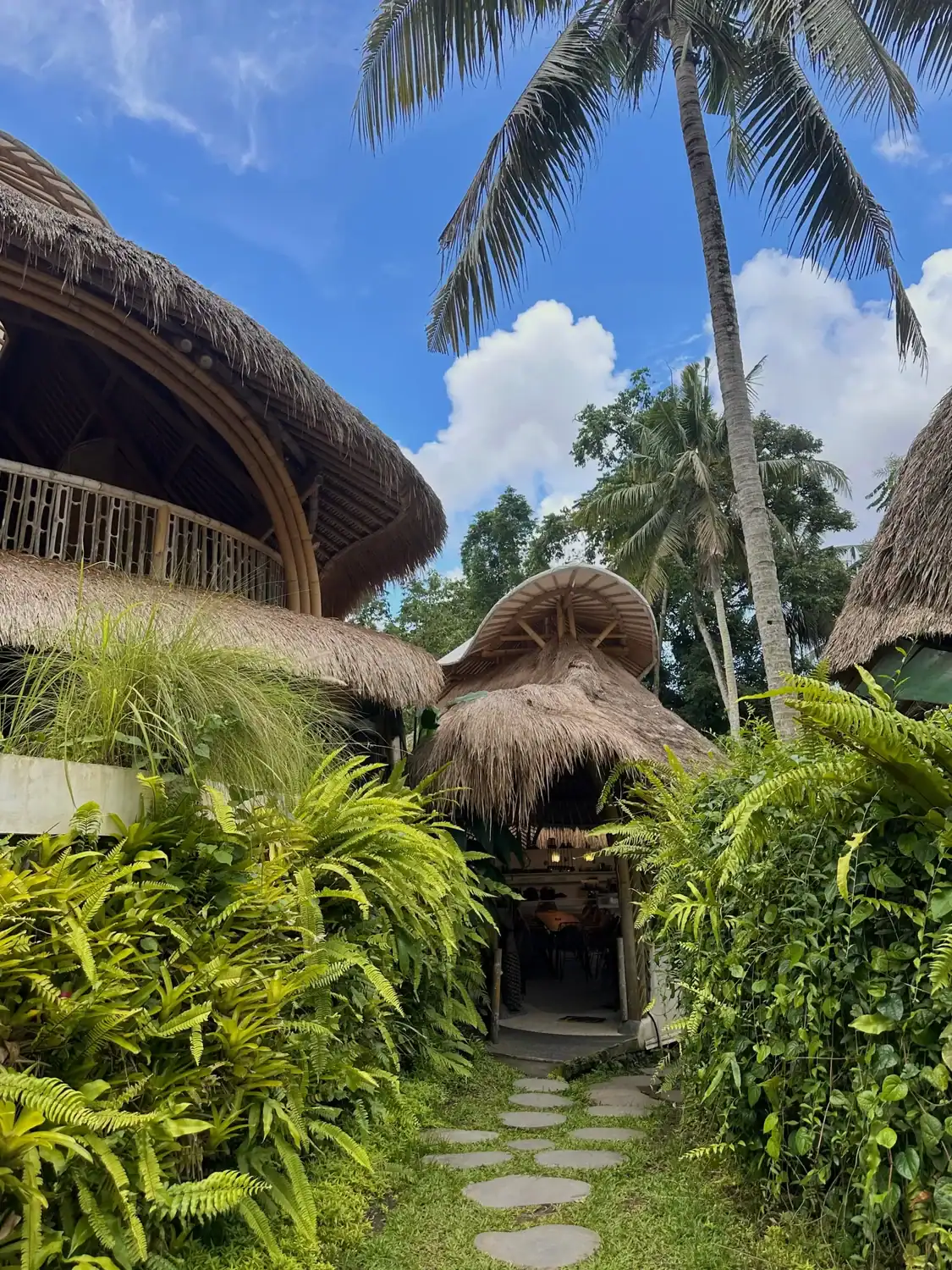
After House of Om, I knew I wanted fewer students and a more focused setting. That’s how I found SKY Yoga and Meditation.
SKY has the most comprehensive syllabus I’ve seen among yoga schools. And it stayed true to my whole experience.
Because the founder and our main teacher studied at Kaivalyadhama Institute in India, the world’s first yoga college, the whole experience felt like studying in a university. It was thorough, well-explained, and properly structured.
All our teachers were very knowledgeable and highly experienced in their areas. What I liked as well was that its focus was Traditional Hatha Yoga. Pranayama, shuddhi kriyas, asana, theory, meditation, and teaching methodologies all had equal time and importance.
That said, be prepared: this is a rigorous training and we only got one full day off. I talked to one of my classmates and they said that this is how they did their YTT in India.
SKY is located in Pejeng, a village east of central Ubud. About 20 minutes from central Ubud by motorbike. We stayed in an eco-village surrounded by forest.
I did my 300-hour at SKY Yoga and our cohort had only five students. For someone who draws energy from large groups, that may feel quiet. For me, it was exactly right.
After both the 200-hour and 300-hour, SKY offers a free 3-day Sound Healing course. I took it and it made my YTT more diverse and meaningful.
SKY holds a strict view on what yoga actually is. Because they’re so rooted in traditional Hatha, modern styles like Vinyasa sit outside their definition. You’ll learn why they uphold it. But if you come from a Vinyasa background and you love it, be prepared for that criticism to come up regularly.
SKY is for you if you’re ready to go deep into traditional Hatha Yoga with a strong emphasis on meditation, philosophy, and lineage. It’s also a great fit for introverts who value focused individual attention over social energy.
This school will be tough if you’re doing your first YTT without an existing practice foundation, or if you need the energy and support of a large cohort to feel sustained. If you like Vinyasa or Ashtanga, you won’t learn it here; however, we had days where we also had 90 minutes of practice with these styles.
SKY’s 200-hour early bird starts at $2,697 for a shared bamboo room.
All Yoga Training Bali
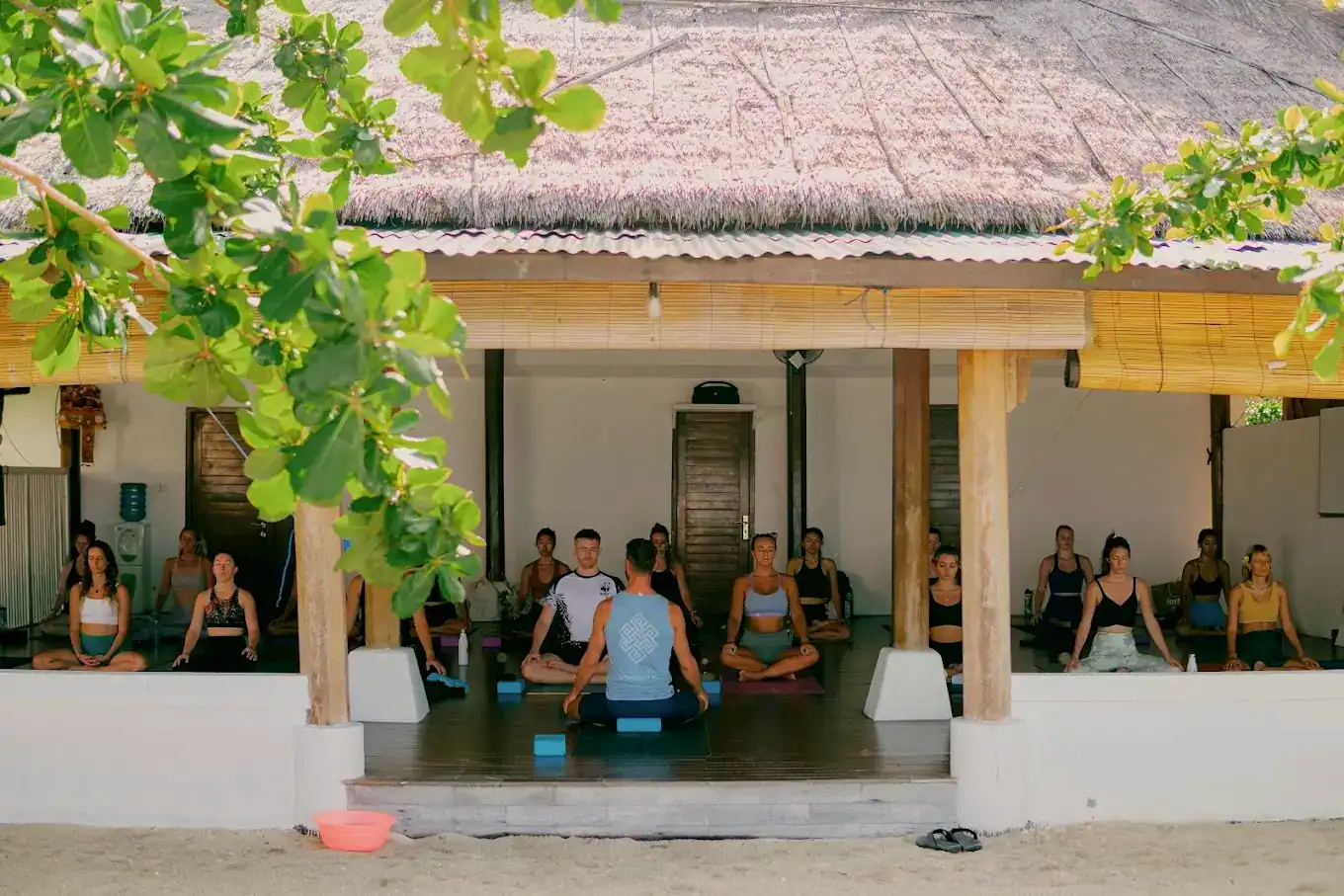
All Yoga Training Bali is one of the best yoga teacher trainings in Bali if location matters deeply to you. If I had to choose the most beautiful setting from this list, this would be it.
Nusa Lembongan removes you from the noise, traffic, and social distractions of Ubud. Instead of squeezing training between cafés, shops, and crowded streets, you’re on a small island surrounded by ocean, sunsets, and slower village life. It’s easier to focus, rest deeply, and fully immerse in your YTT.
All Yoga has a dedicated beachfront shala right on the ocean. After class, you can run straight into the water.
What’s also unique about All Yoga Training is how they approach the two levels differently. The 200-hour focuses on Ashtanga Vinyasa, while the 300-hour covers Yin Yoga and Rocket Yoga. Definitely modern, and both are styles I’ve noticed a lot of studios looking for teachers in.
They also put real emphasis on building your confidence to teach. You do your teaching practice from Day 1, while most schools only start it in the second week.
Although All Yoga Training focuses on specific styles, you’ll also practice kriyas, pranayama, and meditation every morning, and learn about functional anatomy, yoga philosophy, and yoga history.
All Yoga is for you if you have an existing practice and want an Ashtanga foundation in the best place you can think of. The 300-hour is worth serious consideration if Yin or Rocket Yoga is something you want to offer. I was actually considering their 300-hour myself. I had already completed a 50-hour Yin training and was teaching it in studios.
It’s not the right fit if you’re a complete beginner (though I’ve heard of several beginners doing well), if staying close to Ubud matters to you, or if you want to focus on traditional Hatha.
The 200-hour starts at $2,950 USD, with free accommodation for the first 10 sign-ups. Unlike my other recommendations here, this doesn’t include meals. You do have easy access to restaurants and cafes though, and prices in Lembongan are way cheaper than on the mainland.
Zuna Yoga

If you’re a holistic practitioner or want a school that combines tradition with modern science, Zuna Yoga is the best fit for you.
Zuna’s curriculum was built over 30 years of study. Their 200-hour YTT uses somatic movement, deep conscious breathing, meditation, and self-inquiry to help students reconnect with their true self.
Instead of only learning abstract or mystical concepts intellectually, you’re guided to understand them through direct experience. That’s what makes Zuna different.
A lot of graduates mention that it helped them face the fears and decisions they brought to Bali. Remember when I said in the intro that I quit my job? That happened during my own YTT. Zuna gives people that same kind of space. Not just to learn about yoga or to teach, but to gain a deeper understanding of themselves.
They accept students by application only, cap their cohort at 15, and are based in a family-run sanctuary in the village of Tabanan.
Zuna is for you if you want something that challenges you intellectually as much as physically, or if you’re looking for a more holistic approach to your practice or teaching.
It’s not the right fit if extended silence is difficult for you, or if you don’t like daily assignments and writing personal reflections. You’ll need to complete those to register with Yoga Alliance as an RYT200.
The 200-hour starts at $2,500 for the first five sign-ups, accommodation and meals included.
Samasti Yoga
I can’t count how many times I’ve met someone in a YTT, or thinking of doing one, whose main goal wasn’t to teach but to deepen their practice or find themselves through yoga.
Samasti Yoga understands that, and it’s what makes this school the most different of everything on this list. It’s not just a teacher training. It’s a training in being human.
Samasti offers a safe, loving space that allows for reflection, curiosity, and inner growth. Isn’t that why we were drawn to yoga in the first place?
The curriculum covers Functional Hatha combined with Somatic Therapy. Trauma-informed, nervous system-aware, with shadow work alongside asana. Your anatomy sessions are even led by physiotherapists.
Although Samasti is in Canggu, it’s away from the main strip and you’ll have a luxurious villa in the rice fields.
What I also noticed is that Samasti’s community approach is built into the daily schedule. You get three hours for lunch (I’ve always wanted this in my own YTT for proper integration, connection, or a nap) and evening lectures or special events. You also live with the teachers and share meals with them twice a day. That intimacy is built into the structure on purpose.
If you’re already drawn to Samasti, something in you probably already knows why.
Samasti is for you if you’re coming to YTT not just for the certification but for something deeper: clarity, healing, or integration.
It’s not the right fit if you want a physically dynamic or style-heavy training, or if you’re not ready to go somewhere deeper than the mat.
They cap at 20 students, which keeps the group intimate throughout the 29 days. The 200-hour early bird is $3,190, all-inclusive.
Ulu Yoga
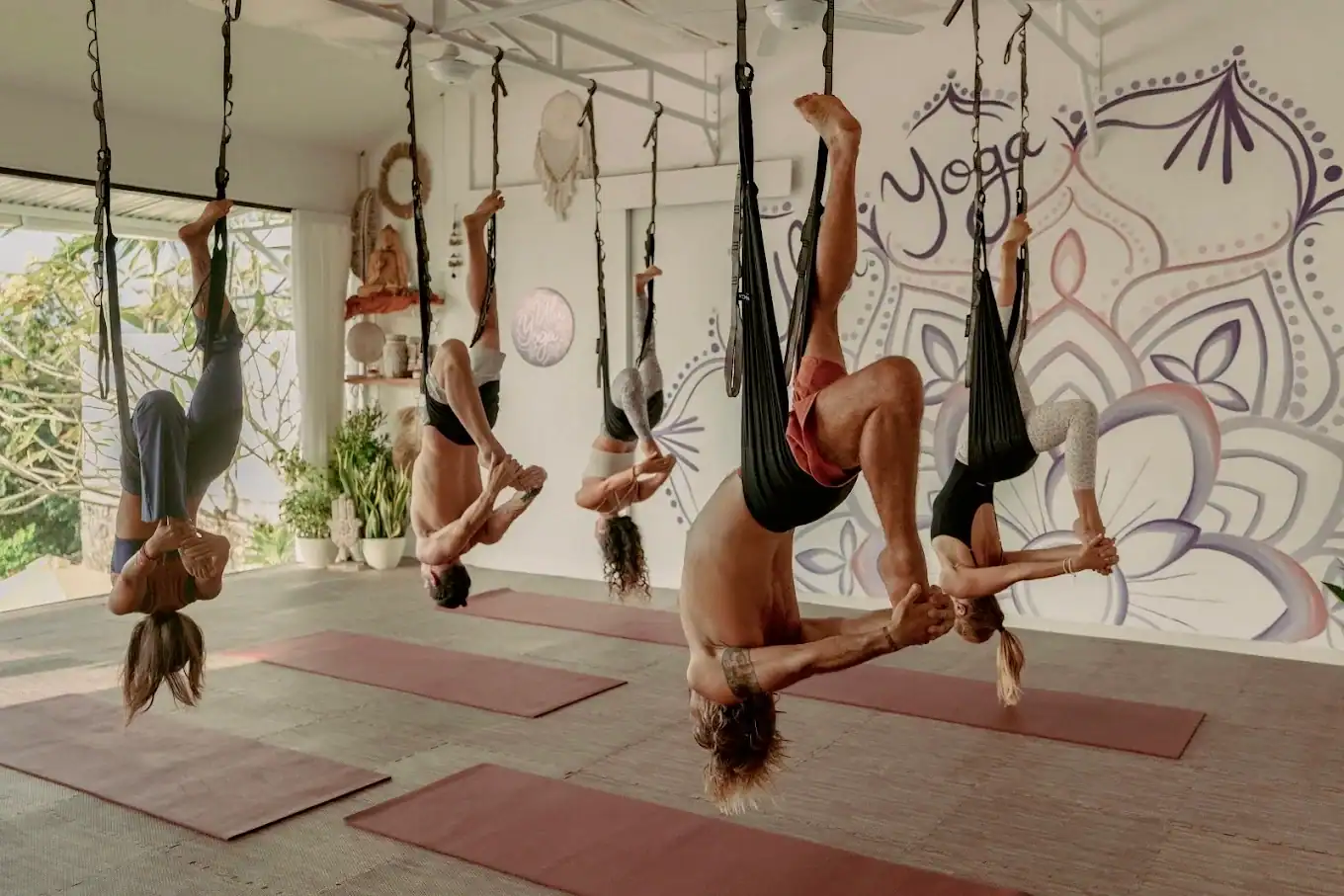
I would choose Uluwatu over Ubud any day for a place to stay for three weeks or more. No wonder the location alone makes Ulu Yoga stand out as a YTT choice.
The shala is near Bingin Beach, one of the best beaches in Uluwatu. The ocean is visible from your mat and the nearest beaches are a few minutes’ walk. Ulu puts you in cliff, surf, and turquoise water paradise.
It stands out because no other school in this guide includes aerial yoga as part of the actual curriculum. Most schools offer it as a separate 50-hour training.
Ulu also offers their 200-hour YTT in 10, 14, 21, and 28-day options. The 10, 14, and 21-day options are hybrid programs combining in-person time in Bali with online study you complete beforehand. With the full 28 days, you get to choose between specializing in aerial or yin for your final week.
Although aerial is Ulu’s core strength, the foundation is Hatha and Vinyasa, with Aerial, Acro, and Yin integrated across the program. It’s the widest style range in this guide.
Ulu is for you if you want the broadest style range. It’s especially worth considering if you love aerial yoga and the beach lifestyle. It’s not the right fit if you want deep traditional lineage or philosophical immersion. Ulu’s strength is variety.
Cohort sizes run from 15 to 25. The 28-day 200-hour YTT starts at $3,350 for a shared accommodation, breakfast on training days, sauna, and a 60-minute massage. [VERIFY: confirm current 28-day pricing from uluyoga.com before publishing]
Loka Yoga School
There’s a difference between being a certified teacher and being prepared to teach. Loka Yoga School is known for preparing its students to be confident teachers, with a teaching toolkit that goes further than any standard 200-hour.
They put emphasis on the art of teaching, the art of sequencing, and biomechanics. Yann, the anatomy teacher, brings a background in cardiac surgery and emergency paramedicine.
His anatomy classes are medical-grade: practical, precise, and taught in a way that will help you and your students make sense of what’s happening in your body. No other school in this guide has anatomy at that level of clinical grounding.
The school is in Kedungu, near Canggu, steps from the beach and surrounded by rice fields. Their new glasshouse shala has floor-to-ceiling windows, air conditioning, and ocean views. It’s a purpose-built dedicated space.
Loka is for you if you want the widest real-world teaching toolkit in a 200-hour YTT. Specifically if you want to use creative expression as a teaching tool and leave with anatomy knowledge that goes beyond the standard curriculum. It’s not the right fit if you want a deeply philosophical or spiritually transformative experience.
The 200-hour complete package starts at $2,900, covering the training, two meals per day, and a private room. They cap at 20 students and the program runs 28 days.
Frequently Asked Questions
What’s the difference between 200Hr, 300Hr and 500Hr?
200-hour (RYT-200): The foundation. Minimum standard to start teaching professionally. Covers asana, anatomy, philosophy, and methodology.
300-hour: The advanced level. You cannot take it without completing the 200-hour first. It builds on the foundation and goes deeper, not broader. After completing both, you register as an RYT-500. There is no standalone RYT-300 designation.
500-hour (RYT-500): The combined total of both. You can complete them at the same school or two different Yoga Alliance registered schools. This is the credential most studios, retreats, and corporate clients look for when hiring senior teachers. RYT-500 holders can also lead teacher trainings and provide continuing education.
Do I need prior yoga experience for a YTT in Bali?
It depends on the school. House of Om and Ulu Yoga are genuinely beginner-accessible. The rest require a consistent existing practice. You’ll also need a completed 200-hour YTT before joining any 300-hour program.
Is Yoga Alliance certification important?
For teaching internationally, it’s the most widely recognized standard. The RYT designation, starting at 200 hours, is what most studios ask for when hiring.
A 500-hour certification opens more doors at higher-end studios and retreats. Every school in this guide holds Yoga Alliance RYS status, but you can verify any school through the Yoga Alliance school directory.
How long is a 200-hour yoga teacher training in Bali?
Typically 19 to 29 days, depending on the school. Some schools also offer a hybrid option where you complete part of the curriculum online, which can shorten your time in Bali.
Can I actually make money teaching yoga after a Bali YTT?
It’s possible, but probably not as a sole income source, at least not at the start. I was accepted by two studios quickly after finishing my YTT. I teach corporate retreats, workshops, and studio classes. But I can’t sustain a living on teaching alone. The market is competitive, and in some cities there are more yoga teachers than students to fill their classes. That said, I’ve also met a lot of teachers who made it work by teaching online and hosting retreats.
What’s the best time of year to do a YTT in Bali?
If you want to pair it with sightseeing or beach time, Bali’s dry season runs roughly May to October and is the more comfortable period for an immersive program.
The rainy season, roughly November to April, is quieter with fewer crowds and offers more space to introspect and practice. I did both of my YTTs in November.
Do I need a special visa for yoga teacher training in Bali?
It depends on the program length. Indonesia’s standard tourist visa on arrival covers 30 days. Programs of 30 days or fewer typically fit within it. Most 300-hour programs run longer than 30 days, so you’ll need an extension. Most schools will guide you through that process.
Time to Find Yours
One thing I know after three years of teaching: every school on this list will give you a certificate. What changes is what you carry back with it.
If one school kept coming to mind while you read this, that’s your signal. Go back to the two questions at the start of this guide. Match your honest answers to the school that pulled at you, and check their availability before the next cohort fills.
The decision doesn’t have to be perfect. It just has to be right for where you are right now.
